
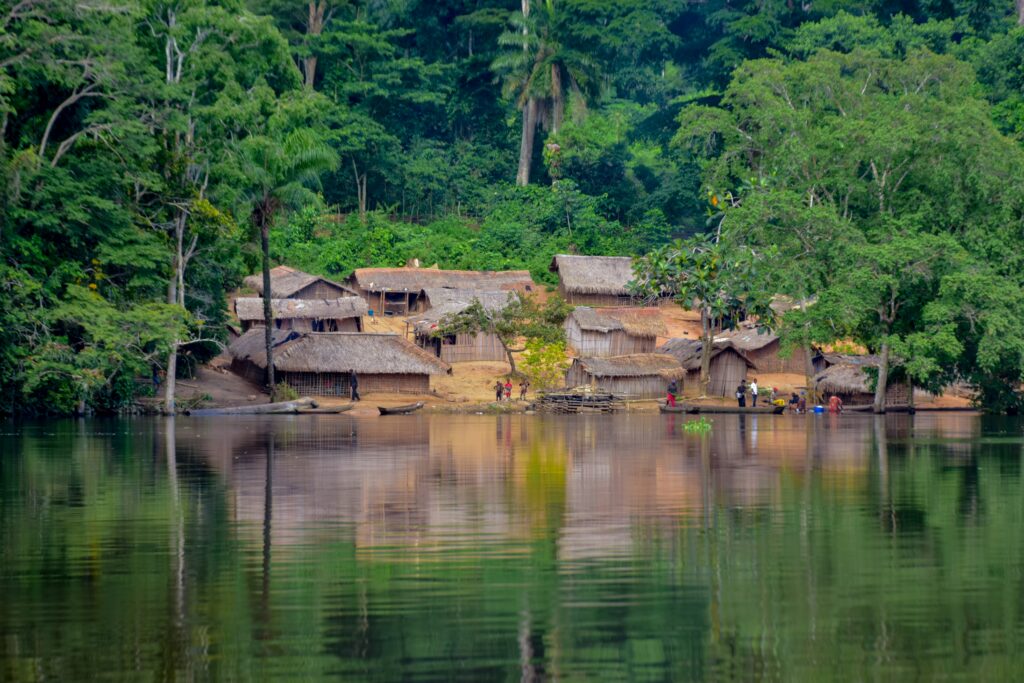
You read the title. If you are wondering which one offers the best experience. I would say, both are unforgettable experiences!
The answer is as complex as a Macaw’s feathers synchronizing its every move while slicing through the canopy with metallic shrieks. The answer could also be as loud as Howler monkeys’ prehistoric roar at dawn. Or it may become as smooth as the jungle river flowing eternally.
The thing is… all brochures promise the same thing: pristine wilderness, exotic wildlife, life-changing encounters with nature. But the Amazon and the Congo Basin are not rivals, rather entirely different entities of green, each with its own logic, its own secrets, and its own way of humbling you.
Both are called the “lungs of the Earth.”
So… if you’re a traveler asking which rainforest experience actually delivers, the answer depends on what you came for.
The Numbers Game
Welcome to biodiversity showdown!
On paper, the Amazon wins the numbers game. Amazon rainforest claims around 10% of Earth’s species: jaguars prowl canopy edges, pink river dolphins arc Iquitos waters, 3,000 fish species dart blackwater creeks. Not to mention 1,300 bird species flying around, casually.
But Congo counters with its epic African giants. Let’s see.. 10,000 western lowland gorillas (20% global population), forest elephants, okapi (zebra-giraffe hybrids), and chimps in Odzala-Kokoua National Park. Most importantly, Congo is the only place on Earth where you’ll find wild bonobo primates.,
Verdict? We say Amazon edges variety, but Congo wins megafauna intimacy.
Indigenous Worlds: Living Knowledge
This one’s easy. Both forests are home to extraordinary cultural universes. Both are equally diverse in human life… its richness and its creativity.
In the Amazon, more than 350 Indigenous groups steward vast territories. Some communities welcome travelers into carefully structured exchanges, sharing medicinal plant knowledge, cosmology, river lore. There is a visible, organized movement toward Indigenous-led conservation and tourism. It’s your perfect opportunity to do a once-in-a-lifetime encounter safely.
In the Congo Basin, forest-dwelling communities such as the Baka and the Mbuti have lived in symbiosis with the jungle for millennia. Cultural encounters here are fewer and more delicate. Most of these communities are shaped by complex political histories.
In both places, the deepest experiences happen when you stop consuming and start listening.
Explorer’s Verdict
If you want relative ease, the Amazon delivers. From Manaus, Iquitos, or Coca, you can board a boat and within hours be deep in the primary forest. There are canopy towers, river cruises, Indigenous-run lodges, and well-established guides.
You can sleep in a hammock, fish for piranha at dusk, and wake to a riot of birdsong. The infrastructure exists to cushion the wild without diluting it entirely.
The Congo, on the other hand… requires commitment. Reaching Odzala-Kokoua National Park or Nouabalé-Ndoki National Park may involve charter flights, rugged roads, and patience with bureaucracy. Tourism here is sparse, often expensive, and logistically complex. But that scarcity is precisely an opportunity for an avid explorer.
Whichever You Pick, Choose Earth
If you want spectacle, scale, and biodiversity so exuberant it borders on surreal, the Amazon delivers immediately. It overwhelms the senses and rewards even short visits with unforgettable sightings.
If you want rawness, an experience that feels less curated and more elemental, the Congo hits differently. It is quieter, more austere, and perhaps more confronting.
But there’s a catch…
The Amazon faces relentless pressure from cattle ranching, soy production, logging, and fires. Meanwhile, the Congo contends with mining, timber concessions, and poaching. Both forests store staggering amounts of carbon; both sit at climate tipping points.
Travel done responsibly can fund protection. Done carelessly, it accelerates loss.
In the end, the better question may not be which rainforest delivers more.
It is which one changes you more? And how much can we help to preserve them?
Both are unforgettable.